
Flip over a bottle of gel polish and the ingredient list reads like an exam you did not study for. Di-HEMA trimethylhexyl dicarbamate. Hydroxycyclohexyl phenyl ketone. It is tempting to skip it entirely and judge the product by how it applies.
You do not need to memorize any of those names. But you do benefit from knowing what the handful of ingredient categories are doing, because that is what explains why two gels that look identical in the bottle wear completely differently on the nail. Here is the short version, written for people who work with these products rather than people who make them.
Why the Chemistry Shows Up at the Table
Every gel, builder, and acrylic system is a small engineered structure. Some ingredients provide hardness. Some provide flex. Some make the product grip the nail, some control how it flows off the brush, and some are there purely to make it cure. The color the client sees is the last thing in the recipe. The performance was decided long before.
Oligomers and Polymers: The Skeleton
Oligomers are short pre-linked chains of molecules. During curing they join together into a much larger network, the polymer, which is the actual solid coating on the nail. The specific oligomers chosen decide most of what the cured product feels like: rigid or flexible, glassy or slightly soft, prone to cracking or prone to lifting.
This is why a builder gel and a gel polish from the same brand behave so differently, and why two gel polishes from different brands do too. They are built on different skeletons.
Photoinitiators: The Trigger
A photoinitiator is the ingredient that absorbs light from your lamp and starts the chain reaction that turns liquid gel into a solid. No photoinitiator, no cure. It would sit there as liquid forever.
Photoinitiators are tuned to specific wavelengths, which is why some formulas cure under LED and some need UV. It is also why this category has drawn attention recently: TPO, one of the most common photoinitiators, was banned in the EU in 2025, and many brands have moved to alternatives.
Monomers and Adhesion Promoters: The Grip
Monomers are the smallest, most mobile building blocks in the formula. They become part of the polymer during curing, and some of them, HEMA most famously, are chosen specifically because they help the product bond to the nail plate.
Adhesion is where most service failures start. Good adhesion chemistry, combined with correct prep, is what stands between you and a lifting callback ten days later. It is also the category with the biggest safety conversation attached, because the small monomers that bond best are also the ones most able to penetrate skin before they cure. That is the whole HEMA story in one sentence.
Pigments: More Than a Color
Pigment sounds simple until you try to formulate with it. Opacity, brightness, shimmer, depth, and how a shade shifts between the bottle and the cured nail are all decided by which pigments are used and how they are dispersed through the base.
Pigments also affect curing. A dense black or deep red absorbs more lamp light than a sheer nude, which is why heavily pigmented shades often need a few extra seconds under the lamp. Cheaper pigments tend to settle, streak, or need a third coat. Better ones cover in two and cure predictably.
Solvents, Thickeners, and Everything Else
The remainder of the list is mostly about handling: ingredients that control viscosity so the product self-levels without running into the cuticle, stabilizers that keep the formula from thickening in the bottle, and UV absorbers that stop the shade from yellowing over three weeks of wear. None of them are glamorous. All of them are why a good formula still applies well on the fortieth bottle.
HEMA and TPO in One Paragraph
These are the two ingredients your clients are most likely to ask about. HEMA is a small adhesion monomer linked to permanent allergic sensitization when uncured product repeatedly contacts skin. TPO is a photoinitiator banned in the EU on a precautionary basis after high-dose animal studies. Neither is banned in the US, but the market is moving away from both. A Longer Ingredient List Is Not a Better Product
A common assumption is that a long INCI list means a more advanced formula. It usually means the opposite. Good formulation is about balance, not volume: the fewest ingredients that work together to hit the target for adhesion, flex, cure, and color. A bloated list often means a manufacturer patched one problem with another additive rather than fixing the base.
Why We Formulate In-House
At Syren Cosmetics, we develop our own gel and acrylic formulas in Wilmington, North Carolina. That is not the industry norm. Many brands buy a finished stock formula from a contract manufacturer and put their label on it, which means they cannot tell you why it behaves the way it does, or change it when it doesn’t.
Formulating ourselves means we choose the oligomers, the photoinitiators, the monomers, and the pigment grades. When a tech tells us a shade is dragging or a builder is running hot under a 96W lamp, we can go back to the recipe rather than back to the supplier’s catalog.
It is also why our gel is formulated without HEMA and without TPO. When you control the recipe, leaving out the two most debated ingredients in the industry is a decision, not a compromise.
The Takeaway
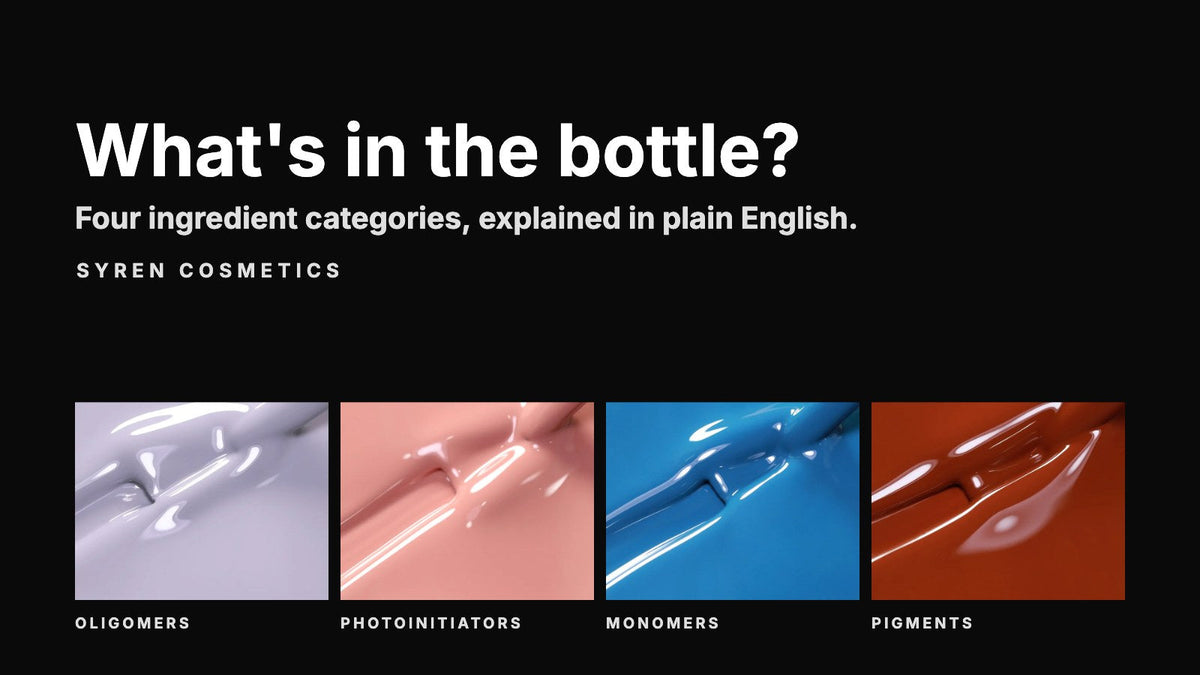
You do not need to pronounce anything on the back of the bottle. You need to know that oligomers decide the feel, photoinitiators decide the cure, monomers decide the grip, and pigments decide the color and the lamp time. Once you can see a formula in those four parts, product choice stops being a guess.
Written by the Syren Cosmetics team. Syren Cosmetics is a professional nail brand that formulates its own gel and acrylic systems in Wilmington, NC.